
About the Lamar County Chancery Clerk
The Chancery Clerk is the clerk of the Chancery Court, the county's court of equity, and the custodian of public land records. In Lamar County the office is held by Jamie Aultman, an elected official. Beyond the court, the Chancery Clerk also serves as clerk to the Board of Supervisors and as county auditor, which makes the office one of the busiest record centers in county government.
Chancery Court files cover divorces, land matters, estates, paternity cases, child support, conservatorships, and adoptions. Most of these cases are public record and open to inspection, though several categories are restricted by law. For land transactions, the Chancery Clerk records and indexes the instruments that establish and transfer title, then preserves them in deed books and deed-of-trust books for the long term. Chancery Court is held two weeks out of each month and convenes at 9:00 a.m.
Lamar County Chancery Clerk
Clerk: Jamie Aultman
403 Main Street
P.O. Box 247
Purvis, MS 39475
(601) 794-3448
Alt: 601-794-8504
Hours: Monday to Friday; call to confirm
The county's official department listing is the best place to confirm current contacts before a visit. For background on the office and its services, see the Lamar County Chancery Clerk land records page, which outlines case types, public access, and clerk duties.
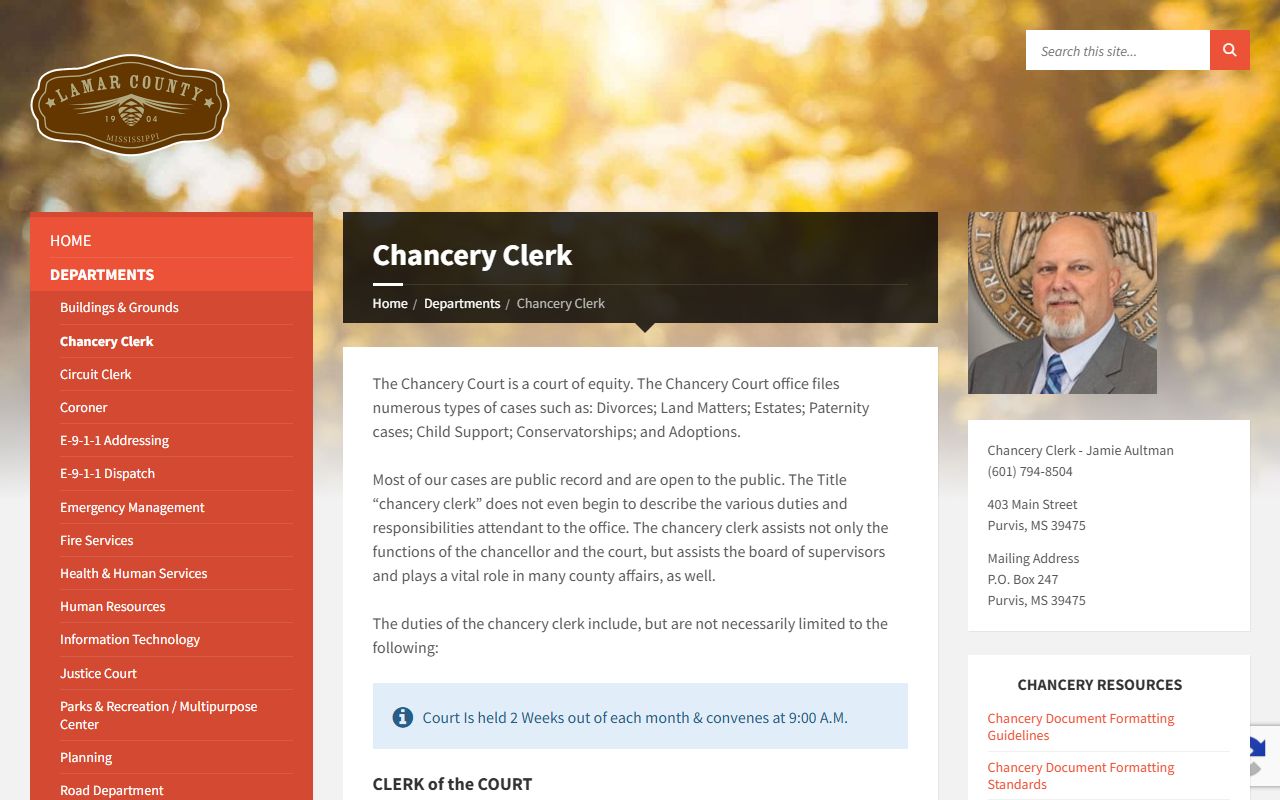
That page is the starting point for understanding which records the Chancery Clerk holds and how the equity court and land-record functions fit together under one office.
What the Lamar County Chancery Clerk Does
The office carries two broad sets of duties. On the court side, the clerk attends Chancery Court, keeps the minutes, opens and maintains chancery suits, issues process for service on defendants, and records activity in the dockets and minute books. The clerk also processes civil commitments, receives filing fees for pleadings and appeals, transmits statistical data to the state Administrative Office of Courts, processes appellate records, and handles domestic-abuse protection orders. On the land side, the clerk records property instruments and maintains the public index.
- Recording deeds, deeds of trust, and other property instruments into the official volumes.
- Maintaining the land index and collecting recording fees.
- Handling tax-sale records, redemption payments, and delinquent real-property tax collections.
- Keeping Chancery Court minutes, dockets, and case files.
- Serving as clerk to the Board of Supervisors and as county auditor.
Because the same office wears a court hat and a recorder hat, a request that mixes a court file with a recorded instrument can usually be answered at one counter. Estate matters often touch both sides at once, since a probate that transfers real property generates both a court file and a recorded deed.
The Lamar County Land Records Index Online
The Chancery Records Online portal provides public access to the index of Lamar County land records. It offers an Official Land Records search, a Land Redemption and Delinquent Tax option, and a Property Fraud Alert sign-up. One point matters before relying on a result: the portal states that the online index is not official. Only the Land Records Index provided in the Lamar County Courthouse is the official index, so certified work should be confirmed against the counter index.
The Official Records Inquiry lets users search by name, date, instrument number, book and page, legal description, parcel, subdivision, section, township, range, and street address. Result grids can be exported to Excel, PDF, or XML, and detail panels show the parties, instrument data, document images, and controls to purchase copies. The portal warns searchers to try every spelling variation and to combine criteria, since a single misspelled name can hide an instrument. The search fields are summarized below.
| Field | Type | Notes |
|---|---|---|
| Search All / Grantee / Grantor | Radio | Search All is the default; choose Grantee or Grantor to limit by role. |
| Matched Name | Checkbox | Narrows name matching. |
| Full Name | Text | Format: Name (lastname, firstname). |
| Begin Date / End Date | Date | Range as far back as 1/1/1800. |
| Recently Filed | Radio | Last 7, Last 30, or Last 90 days. |
| Volume | Dropdown | Defaults to All Books. |
| Instrument Type | Multi-select | Defaults to All Types. |
| Book / Page | Text | Page field includes a "+ greater" option. |
| Instrument # | Text | Search by recorded instrument number. |
| Legal Description | Text | Free-text legal criteria. |
| Parcel ID | Text | Property parcel identifier. |
| Consideration Value | Number range | Minimum and maximum value. |
| Subdivision / Plat | Dropdown | Defaults to All Plats and All Subdivisions. |
| Block, Lot, Section, Township, Range | Text | Legal-description criteria. |
| Quarter / Quarter-Quarter | Checkbox group | NW, NE, SW, SE, plus include-all option. |
| Street / Number | Text | Address criteria. |
| Parcel Num, PPIN, Patent Number | Text | Additional property identifiers. |
You can open the search directly through the Official Records Inquiry land records search, accept the usage terms, and run a query without a subscription, though account login unlocks history and notification tools. Older or non-digitized documents may not appear in the index and should be requested at the counter.
How to Request a Certified Copy or Search Lamar County Land Records
A certified copy carries the clerk's seal and proves that the document is a true record. Title companies, lenders, attorneys, and property owners use them for closings, refinancing, boundary questions, and estate work. The path below moves from a free index search to an official certified copy.
- Identify the instrument by grantor or grantee name, parcel, legal description, or book and page.
- Run the search through the Official Records Inquiry, trying multiple spellings and date ranges.
- Open the detail panel to confirm the instrument number, recording date, and parties.
- Purchase a copy online by credit card, or visit the courthouse for a certified copy from the official index.
- For older records not online, contact the Chancery Clerk and provide as much identifying detail as possible.
- Include a self-addressed stamped envelope when requesting copies by mail.
Online copy purchases are final once submitted, so confirm the instrument before paying. When precision matters for a legal filing, verify the online result against the official courthouse index, which is the only index the county treats as authoritative.
Note: The Chancery portal cautions that online land data is informational and not certified, and the system may be offline for maintenance after normal business hours.
Lamar County Chancery Recording Fees and Document Rules
Recording and copy fees are set by the office and tied to the type and length of each document. The fee schedule states that all fees are due and payable in advance, so a recording packet should arrive complete with payment. The listed filing fee for an instrument covers the first five pages, and each additional page adds one dollar. Documents must meet formatting and indexing standards before they are accepted for recording.
The county publishes the rates and acceptance rules on its Chancery fee schedule for land records, which spells out per-instrument charges and the per-page add-on.
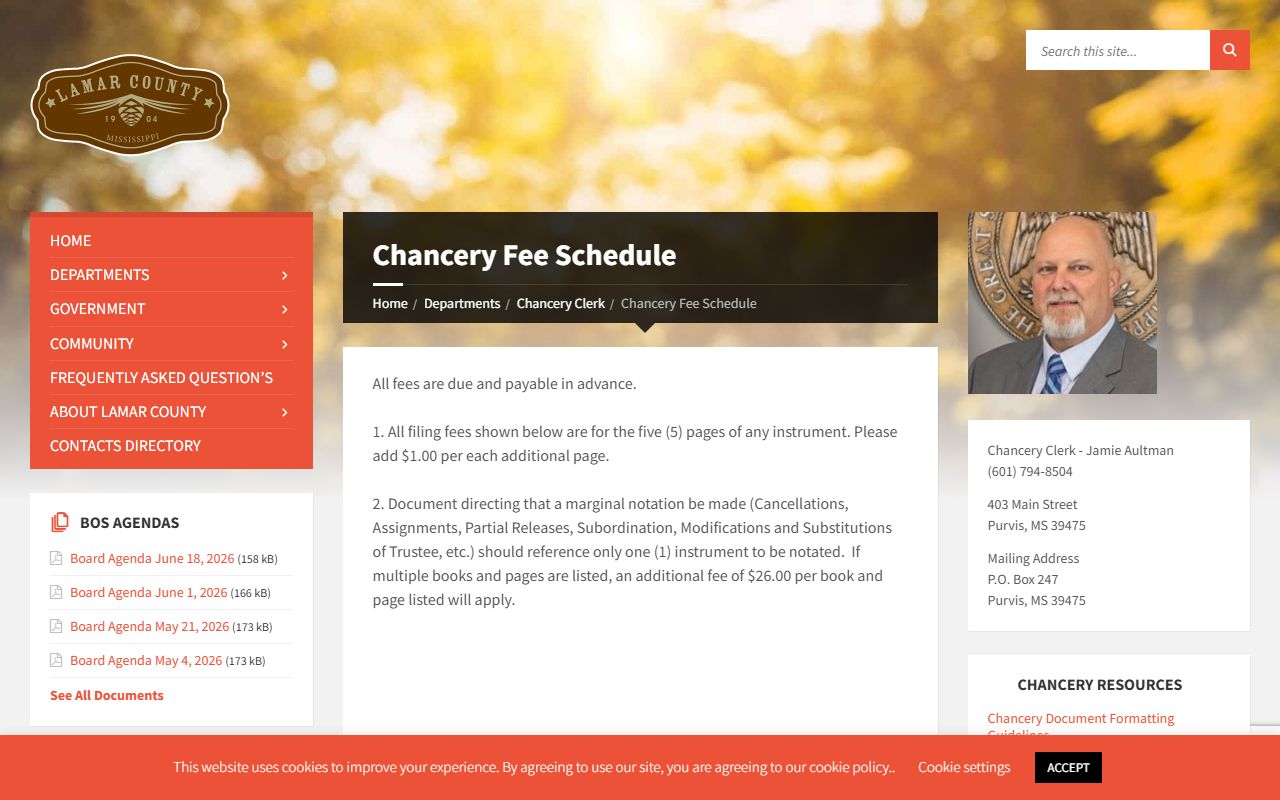
Reviewing the schedule in advance avoids a rejected packet or a short payment. The key recording requirements are summarized here.
- All fees are due and payable in advance.
- The filing fee covers the first five pages; add $1.00 for each additional page.
- A marginal notation that lists more than one book and page costs an extra $26.00 per book and page.
- Each document must include a return address, and deeds must include grantor and grantee address and phone number.
- A notary seal is required, and indexing instructions are required on all deeds and deeds of trust.
- Send a self-addressed stamped envelope for the return of recorded documents.
Formatting standards govern margins, preparer information, and indexing details. The county's Chancery document formatting guidelines for land records lay out how an instrument must be prepared so it can be recorded without delay.
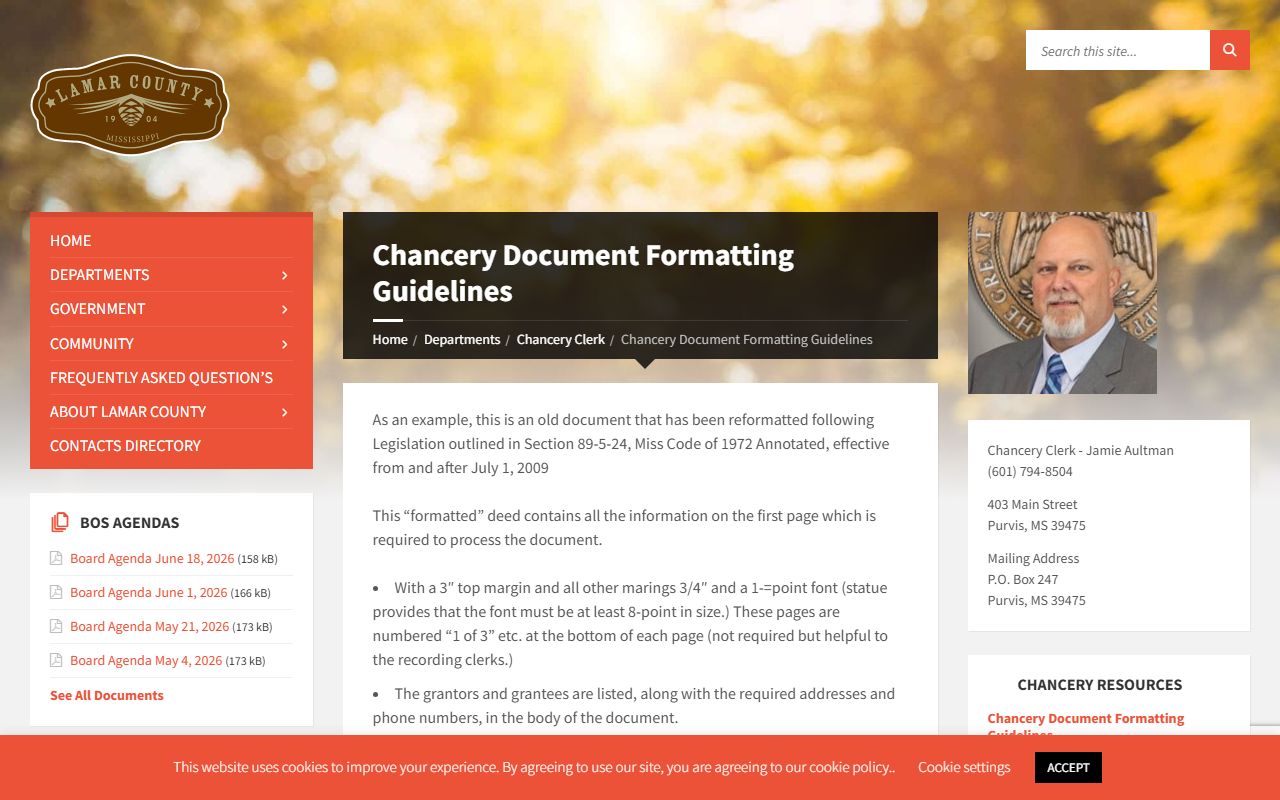
Following the formatting rules the first time keeps a deed or deed of trust moving through the recording queue and into the public index.
Online Copy Charges for Lamar County Land Records
The portal adds its own charge for online copy purchases. Copies bought online by credit card are final, and the service fee is 3.5 percent with a $2.00 minimum. That service fee is non-refundable, which is one more reason to confirm an instrument in the detail panel before completing a purchase. Buyers who need certified work for a closing or court filing should weigh the convenience of an online copy against a certified copy drawn from the official courthouse index.
Restricted Information in Lamar County Land Records
Most land instruments are public, but the images served online are scrubbed of sensitive identifiers. The portal's privacy notice says Social Security numbers, dates of birth, driver license numbers, bank account numbers, and credit or debit account numbers are redacted from images made available through the website. Court files held by the same office can carry their own limits. Adoption records are confidential by statute, youth-court matters are sealed, and civil-commitment and mental-health files are sensitive even though the Chancery Clerk processes them. A recorded land instrument is not the place to expect personal financial detail.
Note: Redaction applies to the online images; if an identifier appears in error, the portal provides a notification tool so the clerk can review the document.
Chancery Clerk and Circuit Clerk in Lamar County
Mississippi splits clerk duties between two offices, and Lamar County is no exception. The Chancery Clerk handles equity-court files and the public land index, including divorces, estates, guardianships, and recorded deeds. Felony criminal cases, civil actions at law, and the court seal for those matters belong to the Circuit Clerk instead. Sending a request to the wrong office is the most common reason a land or court search stalls, so match the record to the right clerk first.
For court records that fall outside equity, the Lamar County Circuit Clerk is the office to contact. When the matter is an estate, will, guardianship, or conservatorship, those filings run through Chancery Court and appear in Lamar County probate records. Land instruments tied to an estate may show in both the court file and the recorded index, so it helps to check each source when tracing property through a probate.