
Criminal Court Records in Lamar County
A criminal court record is the case file a court builds after charges are filed against a defendant. It is not a single document. It is a running collection of pleadings, orders, hearing entries, and the final disposition, all tied to one case number. In Lamar County, the Circuit Clerk is the administrative arm of the court and the keeper of court records for felony matters. Once an indictment, information, or transferred complaint opens a case, the clerk maintains the docket, files the motions and orders as they arrive, and records the verdict or plea and the sentence at the end.
Two court levels produce most criminal records here. The Circuit Court is the primary trial court for felonies, jury trials, and appeals from lower courts, and the Circuit Clerk codes those files as Criminal Felony, with separate codes for misdemeanor, DUI, traffic, and criminal contempt matters. Justice Court sits below it and handles initial appearances, bond hearings on felony cases, search warrants, and the high volume of misdemeanor and traffic prosecutions. The court file is distinct from the booking entry the jail creates and from the charge itself. For the charging documents that start a case, see the arrest and charge records page.
How a Lamar County Criminal Case Moves Through the Court
A criminal case follows a predictable path, and each step leaves its own mark in the record. Reading a file in order, from the first entry forward, shows where a case currently stands and how it got there. The flow below traces a felony matter from the moment charges are filed to the day a sentence is imposed.
Case flow: Charges Filed › Arraignment › Pretrial / Motions › Plea or Trial › Disposition › Sentencing
| Stage | What Happens |
|---|---|
| Charges Filed | A grand jury indictment, a prosecutor's information, or a transferred complaint opens the case and assigns it a number. |
| Arraignment | The charges are read in open court and the defendant enters a plea of guilty, not guilty, or no contest. |
| Pretrial / Motions | Both sides file motions, exchange discovery, argue bond, and set hearing dates that are entered on the docket. |
| Plea or Trial | The case resolves by a negotiated plea or moves to a bench or jury trial that ends in a verdict. |
| Disposition | The court records the outcome: guilty, not guilty, dismissed, or otherwise closed. |
| Sentencing | After a conviction the judge orders confinement, probation, fines, costs, or restitution, and the terms are filed. |
Lower-level cases compress this path. In Justice Court, misdemeanor pleas are heard at 10 a.m. on Tuesdays and misdemeanor trials at 1:30 p.m., so a minor charge can open and close in a single appearance. A felony arrest may begin with an initial appearance and bond hearing in Justice Court before the case is presented to a grand jury and formally opened in Circuit Court.
What a Lamar County Criminal Court Record Shows
A complete criminal file holds far more than a verdict. It identifies the parties, lists every charge as filed, logs each event in date order, and captures the financial terms attached to a sentence. The fields below appear across most felony and misdemeanor case files, though older or sealed matters may show less.
| Field | What It Shows |
|---|---|
| Case Number | The unique identifier, often carrying a local code such as CF for criminal felony or CM for criminal misdemeanor. |
| Defendant | The accused person's name, and the arresting agency, prosecutor, and defense attorney named in the file. |
| Charges | Each offense as charged, with the statute cited and the level marked as felony or misdemeanor. |
| Docket Events | The chronological log of filings: complaint, motions, orders, continuances, hearing settings, and bond actions. |
| Plea | The defendant's formal answer to each charge, entered at arraignment or amended later. |
| Disposition | The current or final outcome, such as guilty, dismissed, acquitted, or nolle prosequi. |
| Sentence | Any confinement, probation, restitution, fines, and court costs ordered after a conviction. |
Some fields are masked even in an otherwise open file. Social Security numbers, dates of birth, driver license numbers, and financial account numbers are routinely redacted, and juvenile identifiers, sealed content, and certain victim information are withheld by law. A docket may also note bond amount and type, surety, and any warrant or capias issued for a failure to appear.
Charges Versus Convictions
Being charged is not the same as being convicted, and a criminal record makes that distinction plain. A charge is an accusation that opens a case. A conviction is an adjudication of guilt that closes one. A file can show charges that were later dropped, dismissed, reduced, or that ended in acquittal, so reading only the opening entry can mislead. The disposition line is the one that states the result.
| Charge | Conviction | |
|---|---|---|
| Stage | Accusation that opens the case | Verdict or plea that resolves it |
| Burden of Proof | Probable cause | Beyond a reasonable doubt |
| Possible Outcome | Dismissed, reduced, acquitted, or convicted | Sentence imposed by the court |
| Public Record | Yes | Yes |
The same logic applies to dispositions. A plea of no contest, a deferred or nonadjudicated outcome, and a dismissal each carry different consequences for the defendant, even though all of them appear in the file. When the result matters, the certified disposition from the clerk is the reliable source rather than a quick index listing.
How to Search Lamar County Criminal Court Records
Mississippi runs felony and county-court filings through Mississippi Electronic Courts, the statewide e-filing and docket system. Lamar County Circuit Court e-filing became mandatory in 2017, and the Circuit and County Court locations went live on the current system in 2019. Public document access through that system can require an account, a subscription, or a per-document fee depending on the user and the material requested. When the online route falls short, the Circuit Clerk counter handles the rest.
- Identify the court level: Circuit Court for felonies, Justice Court for misdemeanor and traffic matters.
- Search the electronic docket by defendant name or case number where access is available.
- Narrow by court, case type code, and date range to isolate the right file.
- Open the case to read the docket entries, the charges, and the disposition.
- Request a certified copy from the clerk when an official record is needed.
For matters that never reached Circuit Court, contact the Justice Court directly at (601) 794-2950, since its misdemeanor and traffic dockets are not part of the land-record portal and are not searchable through the chancery system. A broader look at every record type the county keeps is laid out on the court records page.
Prosecution and Defense in Lamar County Criminal Cases
Two offices shape a felony file even though neither one is the record custodian. The 15th Circuit Court District Attorney's Office prosecutes felonies after law enforcement investigates and a grand jury or prosecutor reviews the matter. That office serves Jefferson Davis, Lamar, Lawrence, Marion, and Pearl River Counties and can be reached for Lamar County matters at (601) 794-3510. It is the right channel for victim services, prosecution status, and plea or sentencing questions, while the clerk remains the keeper of the filed court documents.
The Mississippi Office of State Public Defender maintains the official directory of appointed counsel for people who cannot afford an attorney. Its public-facing list is the dependable starting point for confirming who represents indigent defendants.
The state directory of appointed counsel is published at the Office of State Public Defender website. 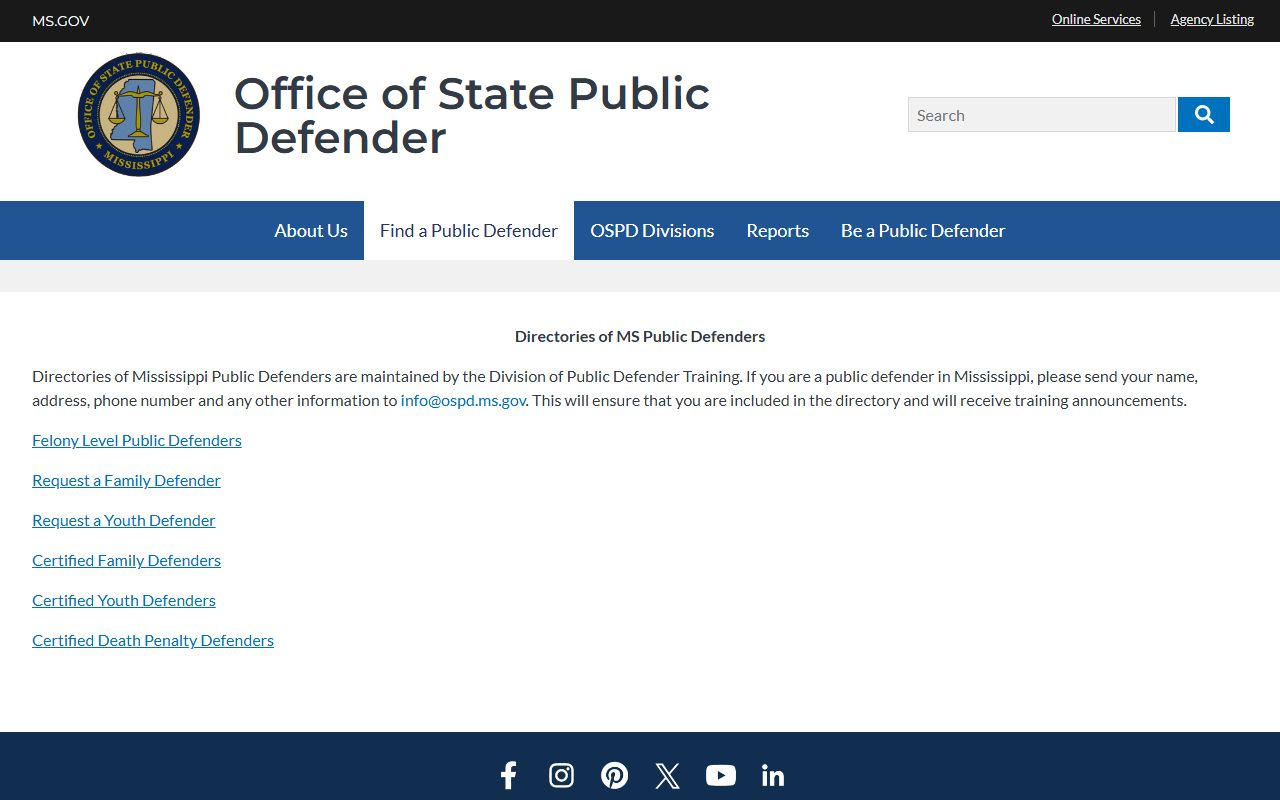 The September 2024 felony directory lists Lamar County public defenders Sam Rosten and Mike Williams, both reachable in Purvis at (601) 794-1023, along with Robert Whitacre, based in Hattiesburg at (601) 545-6122. These attorneys represent indigent citizens accused of felony and misdemeanor crimes, and their appearances are logged in the case file like any other entry.
Public Access to Lamar County Criminal Court Records
Most criminal case files are public. Mississippi's Public Records Act treats government records as open for inspection unless a statute or court rule makes them confidential, and criminal dockets, pleadings, judgments, and sentencing orders generally fall on the open side of that line. Access still follows court rules and confidentiality statutes, so a clerk may redact protected fields or withhold a sealed matter entirely. The office that created or holds the file is always the right first stop.
Key Statutes:
Mississippi Code § 25-61-1 et seq. - the Public Records Act opens government records to inspection unless a law or rule makes them confidential.
Mississippi Code § 25-61-5 - public bodies cannot push a records response beyond seven working days under their adopted procedures.
Agencies may charge the actual cost of searching, reviewing, copying, and mailing records, so a certified packet carries a fee. For criminal files, that means the Circuit Clerk for Circuit and County Court matters and the Justice Court for its own dockets. Booking and custody data are separate again and are tracked through the inmate records channel rather than the case file.
Sealed Versus Expunged Lamar County Criminal Records
Two different remedies limit who can see a criminal record, and they are not interchangeable. A sealed record still exists but is hidden from ordinary public view, with limited access reserved for certain officials. An expunged record is treated as though it never existed for most purposes, and the eligible entries are cleared from public-facing channels by court order. Mississippi handles expunction by petition in the court with authority over the record.
| Sealed | Expunged | |
|---|---|---|
| Visibility | Hidden from public | Cleared and treated as never existed |
| Law Enforcement | Limited access | Very limited access |
| Eligibility | Set by statute or court order, common for youth matters | Eligible misdemeanors and some nonviolent felonies under petition |
The bill text that brings forward Mississippi's expunction statute can be read on the Mississippi Legislature website. 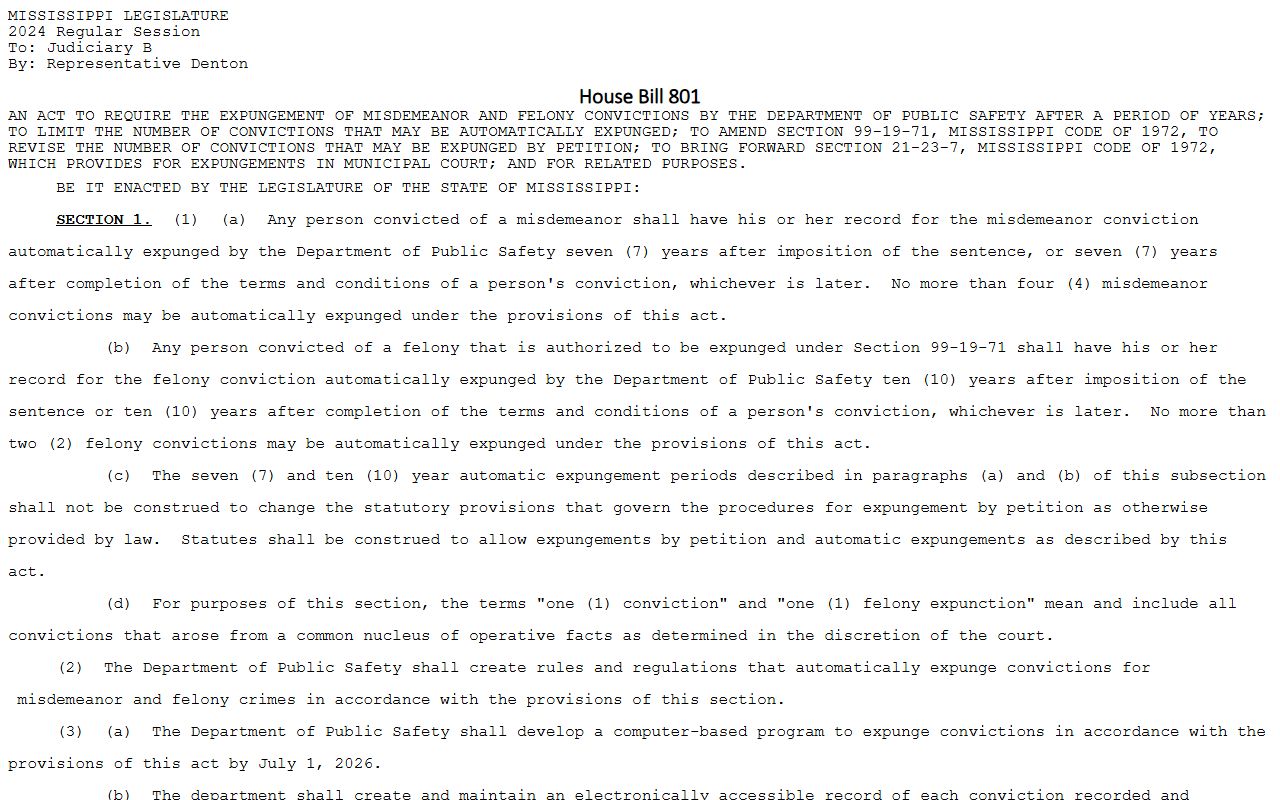 Eligibility under Section 99-19-71 differs for dismissed charges, acquittals, nonadjudications, first-offender outcomes, and certain nonviolent felonies, and a granted order must be distributed to every agency that holds the record. Because the rules are detailed and case-specific, the clerk or a licensed attorney is the proper source for eligibility and the final forms.
Restricted Lamar County Criminal Court Records
Some criminal and quasi-criminal matters are closed to the public from the start. Youth Court proceedings involving people under eighteen are sealed, and Mississippi Code Section 43-21-261 limits disclosure of those records to necessary court staff, appointed advocates, and people named in a youth-court order. Mental health and civil commitment files, handled separately through Chancery Court, are sensitive and should not be treated as ordinary open records. Adoption files are confidential by statute.
Important: Lamar County Court Records is not a consumer reporting agency under the FCRA, and these criminal records may not be used for credit, employment, tenant, or insurance decisions.
Open cases also carry practical limits. Sealed warrants, active investigations, and matters under a protective order may be withheld or redacted even when the broader file is public. When a search turns up nothing, the gap can mean the case was expunged, the record is restricted, or the matter sits in a court level that does not publish a public docket. In each of those situations, a direct request to the clerk or the court of record is the surest way to confirm what exists.