
About the Lamar County Circuit Clerk Office
Martin Hankins serves as the Lamar County Circuit Clerk, an elected official who runs the office in downtown Purvis. The Circuit Clerk position is filled by county voters, so the person in the seat answers to the public rather than to a court appointment. The office works closely with the Circuit Court and the County Court, both of which sit at the same Main Street address.
The clerk's core role is straightforward. The office establishes, maintains, and keeps all records of the court along with the official court seal. The Circuit Clerk is also the administrative arm of the court and handles financial duties for the court system, which includes collecting and distributing monies owed to the court. Contact details appear below.
Lamar County Circuit Clerk
Clerk: Martin Hankins
203 Main Street
P.O. Box 369
Purvis, MS 39475
(601) 794-3478
601-794-8504
Monday to Friday, 8 a.m. to 5 p.m.
What the Lamar County Circuit Clerk Does
The Circuit Clerk sits at the center of the felony and civil-at-law side of the trial courts. Filings come in, get indexed, and become part of the permanent record the office must preserve. The clerk also serves as the financial gatekeeper for court funds, tracking fines, costs, and other payments that move through the system. The duties below show the range the office covers in Lamar County.
- Establish and maintain all Circuit Court case records and the official court seal.
- Act as the administrative arm of the court, supporting judges and court operations.
- Collect and distribute monies owed to the court, including fines and court costs.
- Issue and record marriage licenses for couples applying in the county.
- Support election-related functions assigned to the Circuit Clerk under state law.
The financial role deserves a closer look. Because the clerk collects and distributes court monies, the office tracks fines, court costs, restitution, and assorted fees connected to active cases. Those payments tie back to specific case files, so the financial and record-keeping duties reinforce each other. A person settling a balance on a Circuit Court case usually deals with this office rather than a separate treasurer. The clerk also indexes incoming filings so that a case can be retrieved later by number or party name, which is the practical foundation for every records search the public makes.
Lamar County Circuit Clerk Case-Type Codes
Court records in the county carry short letter codes that mark the type of case. These codes show up on dockets, file labels, and index searches, so recognizing them helps anyone tracking a matter through the Circuit Clerk. The office groups its codes into a criminal division and a civil division. The criminal codes cover felonies, misdemeanors, and several specialized categories.
| Code | Criminal Case Type |
|---|---|
| CF | Criminal Felony |
| CM | Criminal Misdemeanor |
| DT | DUI |
| TR | Traffic |
| JA | Juvenile Abuse |
| JD | Juvenile Delinquency |
| J | Juvenile |
| CC | Criminal Contempt |
The civil division uses a broader set of codes because equity, family, and special-remedy matters all carry their own labels. Several of these case types, such as Chancery and Dissolution, point toward records that the separate Chancery Clerk actually holds. The full civil list recorded for the county appears here.
| Code | Civil Case Type |
|---|---|
| CH | Chancery |
| D | Dissolution |
| ED | Eminent Domain |
| F | Family |
| L | Law |
| LM | Law Minor |
| MH | Mental Health |
| MR | Miscellaneous Remedy |
| MC | Municipal Corporation |
| OP | Orders of Protection |
| P | Probate |
| SC | Small Claims |
| TX | Tax |
Finding the Lamar County Circuit Clerk Online
The county publishes a department page for the office that confirms the clerk's role and lists the local case-type codes. It is a useful starting point before a phone call or counter visit. The county's Lamar County Circuit Clerk page shows the office card and the duties tied to court records.
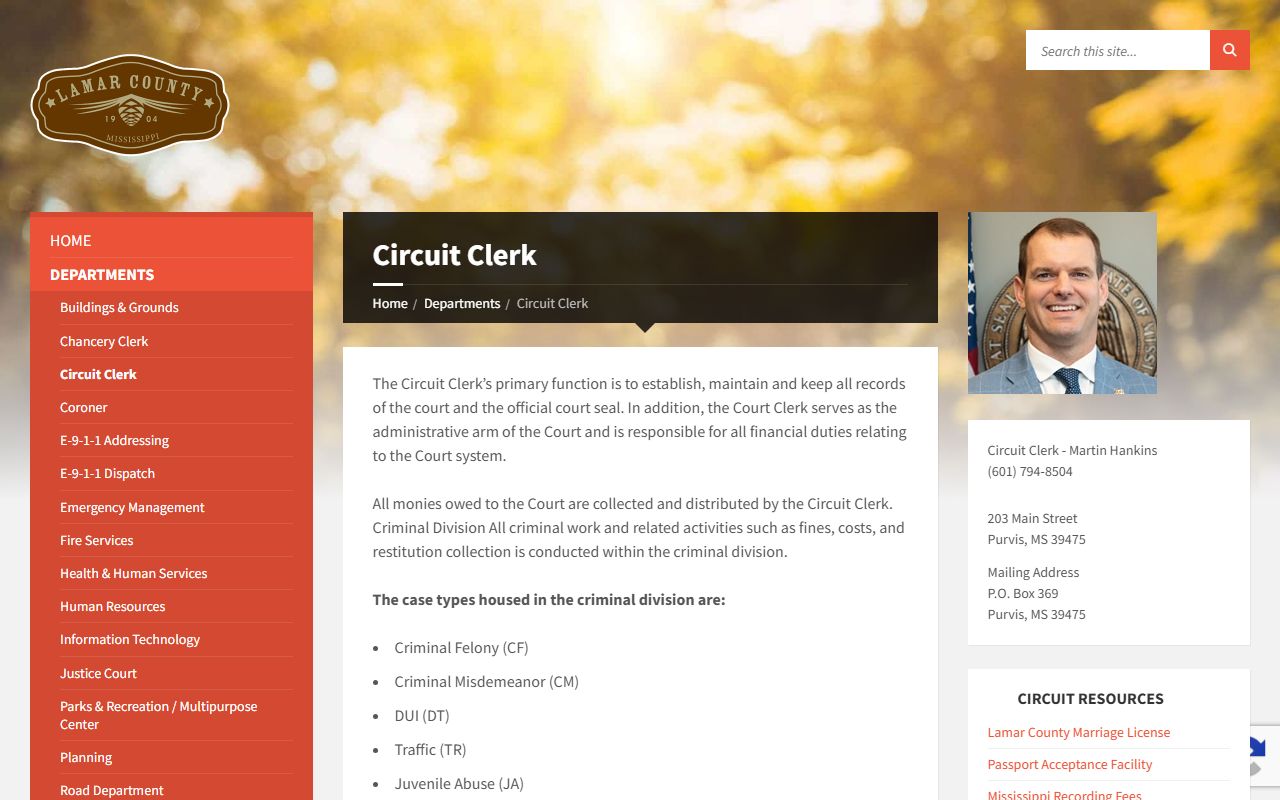
Use that page to confirm the current mailing address and phone numbers before sending a request. Numbers and staff can change after an election or a county reorganization, so checking the official source first keeps a records request from going astray.
How to Request a Certified Copy
A certified copy carries the clerk's seal and signature, which proves the document is a true copy of what the court holds. People need certified copies for background matters, name or status verification, appeals, and many legal filings. The Circuit Clerk produces these for Circuit Court and County Court records kept by the office. The steps below outline the usual path.
- Identify the case number and the names of the parties so the clerk can locate the file quickly.
- Confirm the office holds the record. Felony and civil-at-law matters belong here; land, estate, and divorce files do not.
- Contact the office at (601) 794-3478, or visit the counter at 203 Main Street, to request the specific document and ask about the current copy and certification charge.
- Submit the request with payment, then pick up the certified copy in person or arrange to have it mailed.
Note: Sealed, expunged, and juvenile records are restricted by law, so the clerk cannot release certified copies of them through an ordinary public request.
Have the case number ready whenever possible. A name search across years of filings takes longer and may turn up several matters with similar parties. Older paper files that predate electronic filing can take extra time to pull, and some documents may need to be located in storage. Asking the office about turnaround and the current charge before submitting payment helps set expectations, especially when a copy is needed for a deadline.
Marriage Licenses at the Lamar County Circuit Clerk
Marriage licenses in the county run through the Circuit Clerk rather than a health office or chancery counter. Couples apply together in person at the office. Each applicant brings one form of identification, such as a driver's license or a certified birth certificate, and the fee is $36.00, payable in cash or by credit. If a parent or legal guardian must sign to approve the license, that person also has to appear and show identification.
One detail trips up many applicants. If either party has been married before, the couple must provide the date the last marriage ended by death or divorce. Bringing that information to the counter avoids a return trip. The county marriage license page lays out the same local requirements. Couples seeking the divorce side of a record, rather than a new license, should look to the Chancery Court instead.
Electronic Filing Through Mississippi Electronic Courts
The clerk's records work now runs largely through Mississippi Electronic Courts, the statewide e-filing and case system. Electronic filing in the county's Circuit Court became mandatory on May 30, 2017, after a short voluntary period that began earlier that month. The state's Mississippi Electronic Courts information explains how the system supports filing and electronic case access across participating courts.
For the local court, the MEC court-information record lists the Lamar Circuit Court and Lamar County Court at 203 Main Street with a go-live date of November 4, 2019. Public document access through MEC can require an account, a subscription, or payment depending on the user and the document. When online access falls short, the fallback stays the same as it has always been. Visit or call the Circuit Clerk counter and request the file directly. The county's Circuit Court pages tie closely to this same record system.
When to Use the Lamar County Chancery Clerk Instead
The single most common mistake is assuming one clerk holds everything. The county runs split clerk offices, and the Circuit Clerk is not the Chancery Clerk. The Circuit Clerk keeps felony criminal cases, civil actions at law, marriage licenses, and the court's financial records. A different office, the Chancery Clerk, keeps the equity-court files that many people actually need.
Divorce decrees, estate and probate files, guardianships, conservatorships, and land and property records all sit with the Chancery Clerk at a separate Main Street address. Jamie Aultman serves as the Chancery Clerk, and that office also holds board minutes and public land indexes. If a record involves a deed, a will, an estate, or a divorce, the Circuit Clerk will redirect the request. For those matters, start with the Chancery Clerk instead. Sending the request to the right office the first time is the fastest way to get a usable copy, since neither clerk can certify documents the other office maintains.